Hospitality, Direct Bookings, Web Design
Booking engine or booking request form: what a small East African hotel actually needs
Does your hotel website need a booking engine, or will a booking request form do? What each one costs to run, what guests see and how to choose.
, 6 min read
"Should we pay for a booking engine, or is a form on the website enough?" If you run a guesthouse on Lake Victoria or a twelve-room hotel in Kigali, someone has probably given you each answer. The software seller says guests expect to book and pay in one go. Your front desk says half of them want to ask a question on WhatsApp first.
Both can be right. The better choice depends on how many rooms you juggle, who keeps the calendar up to date and how your guests like to pay.
Below we look at each, then show what a good request form looks like on concept sites we designed for invented hotels, such as Shwari Bay. Their names and rates are made up.
What a booking engine does, and what it takes to run
A booking engine takes a guest from choosing dates to a confirmed, paid room without anyone on your team touching it. To do that it needs live availability, so your calendar has to be right at every hour of the day. It also costs money to run, through a monthly fee, a cut of each booking, or both.
Live availability is the part owners tend to underestimate. If you also sell on Booking.com or Expedia, the engine has to know the moment a room goes there, which takes a channel manager linking them all, or the same room can sell twice.
Card payments add the payment provider's fee. And someone still has to load season rates, close rooms for repairs and chase the odd failed payment.
An engine earns its keep when:
- you already run a channel manager or a property management system
- many guests book late at night from Europe or the US and want an instant yes
- you have enough rooms and sales channels that a diary or spreadsheet leads to double bookings
- you want your own rates in Google's free hotel booking links, which need a connected booking partner to send them
What a booking request form does
A booking request form lets the guest pick dates, a room and a party size, see an estimated price and send it all to you in one message. Nothing is confirmed until your team checks the calendar and replies. There's no fee per booking, and it works with whatever you use to track rooms today, even a paper diary.
The trade-off is the wait. A guest who sends a request at 10 pm and hears nothing by lunch may book somewhere else, so a form only works if someone answers within hours. It suits guests who like to ask a question and hear from a person before they commit.
A request form can still price the stay
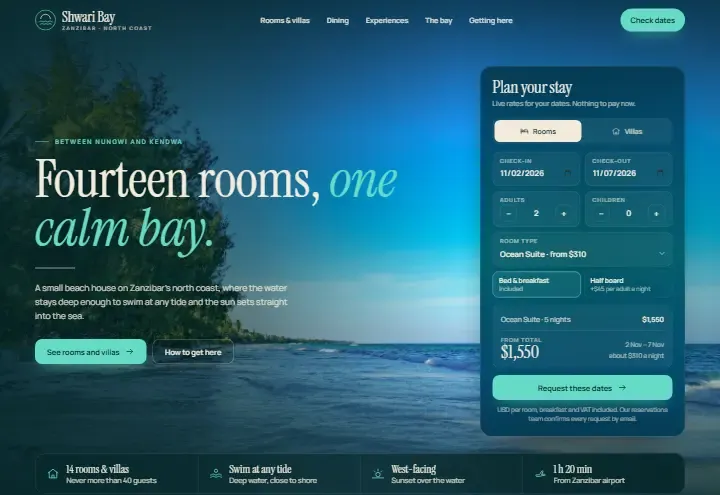
A good form does most of what an engine shows on screen. Shwari Bay is a fourteen-room beach resort on Zanzibar's north coast, and the first thing on its page is a planner: check-in, check-out, adults, children, room or villa, and bed and breakfast or half board. The total changes the moment the guest changes anything.
The planner knows the house rules. Nights in July and August, and from 20 December to 5 January, are marked as peak and cost 25% more. A seventh night comes off the bill, and if four people pick a room that sleeps two, it says so and suggests a villa.
Then "Request these dates" carries the room, dates, guests and meal plan into the booking form. The guest adds a name, an email and how they're arriving, and your team gets a request it can answer in one reply.
Rooms sold by name, each with its own rate
Platforms flatten your rooms into "Double room, sea view". Your own site can give each room its own page or section. Chokaa House, a concept boutique hotel in Stone Town, has nine rooms in four named kinds, and each one shows its size, view, bed, how many it sleeps, a nightly rate and a higher rate for July, August and festive weeks.
Tap "Choose Bahari" under the sea-view room and the booking form selects it for you. Three nights in March with an airport pickup reads $745 before the guest has typed a name. Someone who fell for the iron balcony over the lane can ask for that room by name.

Season rates that price themselves
Camps and lodges charge by season and by person, which is where emailed quotes go wrong. Mawio Camp, a concept nine-tent camp in the Serengeti, prices each night by its own season. A stay that starts in late May and runs into June pays green-season rates for the May nights and high-season rates for the June ones.
It also halves the rate for children aged six to fifteen, adds a single supplement in high season and works out how many tents a big family needs. Park fees sit on their own line, at cost, so the guest can see what the camp charges and what the park charges.
Where the request lands, and how the guest pays
A request can go to your reservations email, to WhatsApp or to both, with the dates, room, party and estimate already written out. Your reply confirms the room and says how to pay: a deposit by mobile money, a bank transfer, a card payment link or the full amount on arrival.
On WhatsApp the message might read "Bahari Room, 12 to 15 March, 2 adults, airport pickup, estimate $745". You check the diary and answer. For guests who live in the region, a deposit by M-Pesa, Airtel Money or MTN MoMo can be the easiest way to hold a room.
Paying on arrival is friendly in a quiet month. For Christmas, Easter or migration season, ask for a deposit so a no-show doesn't cost you the room.
How to choose
Pick a request form if one person handles reservations and checks the calendar every morning, if most bookings start with a question, or if tour operators send you much of your business by email anyway. You pay nothing per booking and can start now.
A booking engine makes more sense if you already have a channel manager, sell many rooms across several platforms, or lose guests overnight because nobody is awake to reply. But budget for the fees, and for the time it takes to keep rates and dates right.
There's a middle path as well. Start with room pages and a request form. If you add an engine later, the Book buttons can point to it, and the rooms, photos and rates on your site stay as they are.
Try it on your phone
Open the concepts on your phone and play with a few dates. When you know which way you lean, book a free call and tell us how bookings reach you today.