Tourism, Web Design, East Africa
Tour operator websites in Tanzania: what a safari site needs before the enquiry
How a tour operator or safari website in Tanzania should compare routes, show prices with park fees included and turn browsing into a planned enquiry.
, 4 min read
A traveller choosing a safari company usually has several tabs open, and many tour operator websites in Tanzania give them the same thing in each: a sunset photo above a list of packages. The operator who gets the enquiry is often the one whose site answers the real questions first. Below are six things a good tour operator website does, each shown on a concept from our gallery.
Each example is a concept site we designed for an invented travel business. None of them is a client, and their prices are illustrations.
Compare your trips side by side
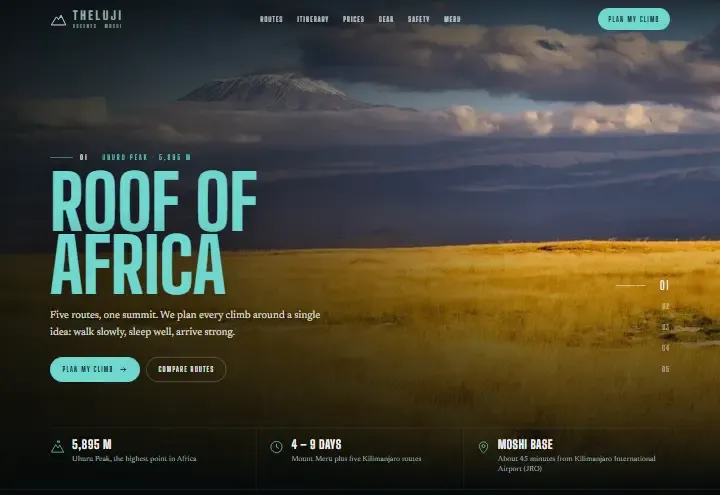
If you sell several versions of the same trip, the buyer's first job is working out the difference. Theluji Ascents, a Kilimanjaro operator in Moshi, puts all five routes in one table: days, distance, huts or tents, acclimatisation, crowds and the starting price. Filters narrow it to the best acclimatisation or the quieter trails.
Below the table, a day-by-day Machame itinerary shows the altitudes, distance, walking hours and climate zone for each stage, with a guide's tip. A climber who has read that page has fewer questions left to email you.
Put the price on the page, with park fees in it
A price that leaves out park fees feels like a trick when they appear later. Ramani Holidays, a safari and beach booking site, says under its search bar that park fees are in every safari price, and a currency switcher moves every price between dollars and shillings. Theluji names all park, camping, hut and rescue fees as included.
A good price block answers what people would otherwise write in to ask:
- who the price is for, such as per person sharing, and what a solo traveller adds
- which season it applies to
- what is included, with park fees named
- what is left out, usually international flights, visas, insurance and tips
Let visitors save favourites before they enquire
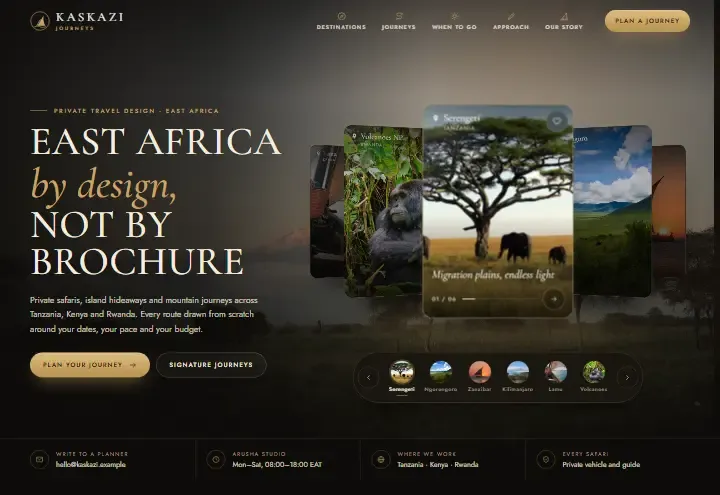
Kaskazi Journeys is a luxury travel designer based in Arusha. Its six destinations sit in a swipeable carousel, and each card has a heart. Save Serengeti and Zanzibar while browsing, and both are already ticked when you reach the enquiry form.
That form then asks for the month, length of trip, number of travellers and a budget band. The planner receives a real brief in place of a one-line "how much?".
Make the enquiry form a planning tool
Upepo Atlas is a Zanzibar island guide with a trip planner at its centre. Visitors set the nights, month, style of stay and pace, then pick what draws them, from reefs and the old town to spice farms, forest and kite surfing. A draft with an estimate for two builds as they go, and one button sends it to a local concierge who replies within a day.
Theluji's enquiry does the same for climbers, updating the estimate as they choose a route, month, group size and extras.
Make short tours bookable in a few taps
A two-hour walk should not need a week of emails. Milango Walks sells Stone Town walking tours. Visitors swipe through eight landmarks, see which walks stop at each, then choose a walk, date, language, start time and group size in one panel. The total shows before anything is sent and there is no deposit: the guide confirms within the day.
Questions a tour operator website should answer
The concepts answer these on the page:
- When to go. Kaskazi has a month-by-month chart for each destination, and Theluji marks the best and the rainy months for climbing.
- Safety. Theluji explains its twice-daily pulse oximeter checks, the oxygen carried on every climb, its turn-around rule and the weight limit on porter loads.
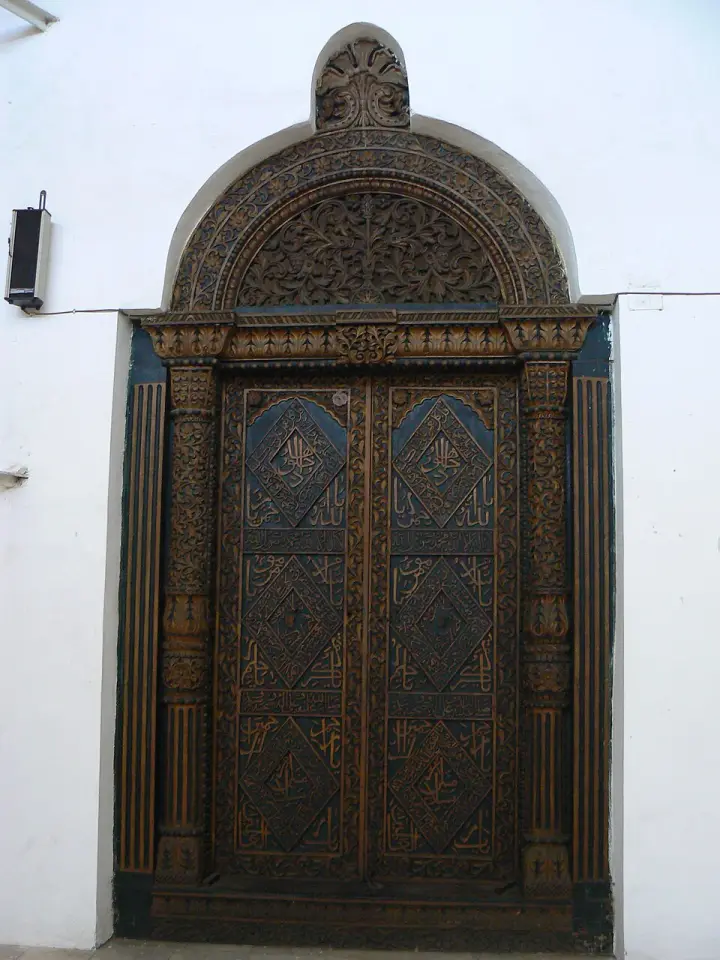
- Local customs. Milango covers dress in the old town, Ramadan, asking before you photograph people and the best hours to avoid the midday heat.
- What happens next. Kaskazi lists its four steps, from a first call to a costed sketch within three working days.
What a site like this costs
Each feature above (a route comparison, a live estimate, a trip planner, a booking panel) belongs in a Big website: $350, paid once when the work is done, with no deposit and no page limit. A simpler site with no moving parts is a Small website at $300. Both go live two weeks after your content arrives, and each has a dedicated manager who looks after it.
In a $350 build, the estimate and booking panel send a request to your inbox or WhatsApp for your team to confirm. Online payments or a full booking engine are quoted separately. The details are on our web design page.
Pick the concept in our gallery closest to how you sell trips, then book a call or message us on WhatsApp. We will tell you what yours would need.